Insights
Does AI Reject Your Resume? What Indian Employers Actually Do With AI Screening (2026)
Most AI hiring tools rank resumes rather than reject them, but they decide who gets read first. What Indian employer data shows, and how freshers adapt.
Edufusion Editorial12 min read
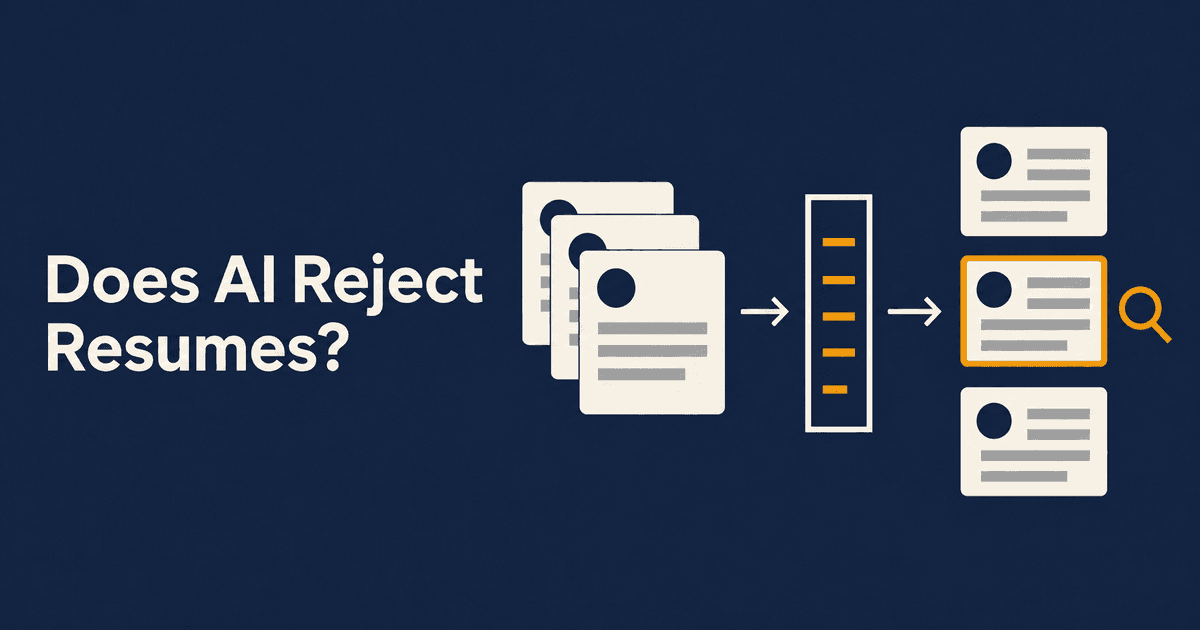
The short answer: This question can mean two things: does AI screening software reject your resume, or do employers reject resumes written with AI? Usually neither happens just because AI is involved, but screening software often decides whether, and how soon, a person reads your resume, and a generic or untrue AI-written resume can get you rejected. In Deloitte India's 2026 campus survey, 72% of organisations said they use AI for resume screening, so your resume has to make sense to software first and to a recruiter second. Where software does reject automatically, vendor documents show it runs on rules the employer sets, such as answers to screening questions, not on a robot judging your words.
Say you apply to dozens of jobs and hear back from only a few. It's easy to believe a machine threw the rest away before anyone looked. Online, you'll see the same line again and again: "75% of resumes are rejected by ATS before a human sees them."
That fear is half right. Most Indian employers now use AI somewhere in hiring. But the famous 75% number has no study behind it, and the way most tools work is different from what the posts claim. This guide shows what Indian employer data actually says, where the myth came from, and what to change in your resume this week.
Does AI really reject resumes?
Sometimes, but mostly in ways the employer chose and you can see. An applicant tracking system (ATS) is software that collects applications and moves them through hiring stages. Many now add AI features that read and score resumes.
There are two very different things these tools do.
1. Automatic rejection based on your answers. Greenhouse, an ATS vendor, lets employers set rules so that "based on an applicant's answer to a question, they will automatically be rejected" (Greenhouse Support, Auto-reject, read 19 Oct 2026). The company says these rules are meant to filter out people who don't meet essential criteria, "like certain license or location requirements" (Greenhouse, Application rules overview, read 19 Oct 2026). These are often called "knockout questions", for example about your location or whether you hold a required licence.
2. Ranking and sorting. Greenhouse's AI matching feature sorts candidates into groups such as Strong, Good or Partial match. Its own FAQ says it "does not auto-reject or auto-advance any candidate" (Greenhouse Support, Talent Matching FAQ, read 19 Oct 2026). A person still decides. But a low score can push you down a long list, and a recruiter with 500 applicants may stop before reaching you.
So the honest answer: software can reject you on a hard rule, and it can bury you in a ranking. It rarely reads your resume and deletes you for a word choice.
How many Indian employers use AI to screen resumes?
Most of them, and campus hiring is no exception. Deloitte India's Campus Workforce Trends 2026 survey of 257 organisations found that 72% use AI for resume screening and 48% use AI-based assessments (Deloitte India press release, 27 Aug 2026). Resume screening was the most common use of AI in hiring in that survey.
Two other employer surveys point the same way. Both come from hiring platforms, so read them as industry data:
- Indeed: Only 5% of Indian employers said they don't use AI-powered hiring tools, and 46% use AI for sourcing and screening, according to Indeed's 2025 Smarter Hiring Report with YouGov (Indeed India, 17 Feb 2026; vendor survey).
- LinkedIn: Among Indian recruiters already using AI, 71% said it helped them find candidates with skills they would have missed (as reported by ETHRWorld, 3 Feb 2026, citing LinkedIn research; vendor survey).
Notice what these numbers measure. They say employers use AI in screening. None of them says how many resumes AI rejects. No Indian survey we found publishes that figure.
Is it true that 75% of resumes are rejected by ATS?
No. There's no credible study behind it. We traced the number back as far as we could.
- Where it started. The earliest version we found is a March 2012 article. It said these systems "kill 75% of candidates' chances of landing an interview," citing Preptel (Computerworld, 4 Mar 2012). Preptel was a company whose service "aims to help job seekers penetrate these systems," as the same article puts it. The article gives no survey, sample or method.
- How it grew. By 2019, the claim had become "three-fourths of all resumes never even get seen by human eyes, according to a study from job search services firm Preptel" (CNBC, 28 Feb 2019). We could not find any such Preptel study.
- Where it is now. It still circulates. In July 2026, two business-school researchers in Canada called it "the most widely repeated claim online" about these systems and noted that "no methodology was ever published" (The Conversation, 5 Jul 2026).
So the number began as a claim by a company selling the fix. It was never measured.
That doesn't mean software never filters people out. A Harvard Business School and Accenture study found that 88% of surveyed employers using recruiting software agreed that qualified high-skills candidates get "vetted out of the process because they do not match the exact criteria" in the job description (Harvard Business School and Accenture, Hidden Workers: Untapped Talent, Sept 2021). That was a survey of US, UK and German executives about what they believe. It isn't a count of rejected resumes, and it isn't Indian data. But it points to the real risk: rigid filters set by employers, not a magic 75%.
What does the software actually look at?
Mostly, how well your resume matches what the employer asked for. The tool compares your resume with the job description and the criteria the employer set. Then it ranks you against everyone else.
Three things affect how you come out:
- Whether it can read your resume at all. In a 2011 test reported by Computerworld, a research firm built a perfect resume for one job and ran it through a leading ATS. The system lost one job entirely and missed several degrees, so the resume scored only 43% relevance (Computerworld, 4 Mar 2012). That's an old test, and tools have improved. But the lesson holds: tables, columns and text inside images can confuse a parser.
- Whether your words match theirs. If the job post says "SQL" and "Power BI", and your resume says "databases" and "dashboards", a matching tool may score you lower. A person would understand. Software may not.
- Whether you trip a hard filter. The Harvard study found 48% of employers filtered middle-skills candidates for gaps in work history of more than six months (Hidden Workers, Sept 2021). As a fresher, read every screening question carefully, for example about your graduation year or location, and answer it truthfully.
What happens after the software?
More testing, often also run by AI. In Deloitte India's survey, 48% of organisations use AI-based assessments, and AI-led video interviews are "emerging as a new screening tool" (Deloitte India, 27 Aug 2026).
What employers want to see is changing too. As AI tools take over routine coding and testing, "employers increasingly want graduates who can work with AI systems, validate their outputs and apply technology to business problems" (as reported by The Economic Times, 14 Oct 2026). Nasscom's Sangeeta Gupta told the paper, "The new kind of freshers companies need are AI-native."
That means your resume isn't the finish line. It's the ticket to tests and interviews where you'll have to show the skills you listed. If your resume says you can use AI tools well, be ready to prove it.
How do you write an ATS resume that both software and people can read?
A good ATS resume is simple for the software and specific for the person. Use this checklist before every application.
For the software
- Use one column and standard headings to be safe. Newer systems handle more layouts, but Greenhouse still lists tables and columns as a reason a resume can fail to parse. Headings: Education, Projects, Internships, Skills, Certifications.
- Save it as a text-based PDF or Word file. If you can't select and copy the text, a parser may not read it either.
- Don't put key information inside tables, text boxes, icons or images.
- Mirror the job post's exact words, where they're true for you. If the post says "Python" and "data visualisation", use those words, not just synonyms.
- Answer every screening question accurately. A wrong "No" can end your application before anyone reads your resume.
For the person who reads it next
- Lead with proof. Put internships and projects near the top. In foundit's job-portal data, nearly six in ten fresher job postings preferred or required internship experience (as reported by Business Today, 6 Aug 2026).
- Show results, not just tasks. "Built a dashboard the placement cell used to track applications" beats "Worked on dashboards". Only write numbers that are true and that you can explain.
- Make every line checkable. Some placement cells now demand it. IIT Madras's 2026–27 rules say students "must submit valid proof for every point mentioned in their resume" (IIT Madras, Placements 2026-27 guidelines). For the 2026 campus and fresher hiring picture, see fresher hiring in India in 2026.
- Make a version for each type of role. A data analyst resume and a software developer resume should not be identical.
Can using AI to write your resume get you rejected?
Not for using AI. You can get rejected for sending something generic or untrue. Recruiters are seeing a flood of AI-written applications. Among Indian recruiters who said hiring had become harder, 53% pointed to a surge in AI-generated applications (as reported by ETHRWorld, 3 Feb 2026, citing LinkedIn research; vendor survey).
Candidates use AI too. Indeed's survey lists CV optimisation (36%) among the ways Indian candidates use AI tools (Indeed India, 17 Feb 2026; vendor survey). So a polished resume alone no longer stands out.
Use AI as an editor, not an author:
- Ask it to check your grammar and suggest clearer verbs.
- Ask it to compare your resume with a job post and list missing skills. Then add only the ones you really have.
- Never let it invent projects, numbers or tools. Anything on your resume can come up in the interview.
- Read the final version out loud. If it doesn't sound like you, rewrite it.
If you list AI tools as a skill, expect to be tested on them. You can prove the AI skills you list with a prompt engineering online test before an employer asks.
How we researched this
Edufusion Editorial read Deloitte India's Campus Workforce Trends 2026 release, the support documents of a major ATS vendor (Greenhouse), and the Harvard Business School and Accenture Hidden Workers report. We added survey data from Indeed and LinkedIn, two hiring platforms, labelled as vendor surveys. To trace the 75% claim, we read the 2012 Computerworld article, the 2019 CNBC article that repeated it, and a 2026 article in The Conversation by two business-school researchers. We left out one article that was marked as an event promotion, not news. Read our editorial standards.
Questions
Does AI reject resumes automatically?
Sometimes. When it does, it's on rules the employer set, such as a required answer to a screening question. Many AI features only rank resumes. Greenhouse says its matching tool "does not auto-reject" anyone (Greenhouse Support, read 19 Oct 2026). But a low rank can mean nobody reads your resume.
Do 75% of resumes get rejected by ATS?
There's no evidence for it. The earliest version we found dates to a March 2012 article citing Preptel, a company that helped job seekers get past these systems, with no study or method attached (Computerworld, 4 Mar 2012). Treat the number as marketing, not research.
Do Indian companies use AI to screen resumes?
Yes, widely. In Deloitte India's 2026 campus survey of 257 organisations, 72% said they use AI for resume screening, the most common use of AI in their hiring (Deloitte India, 27 Aug 2026). Expect software to see your resume before a person does.
How do I make an ATS-friendly resume as a fresher?
Use one column, standard headings and a text-based file, and mirror the job post's exact skill words where they're true. Lead with internships and projects. Nearly six in ten fresher job postings preferred or required internship experience, in foundit data (as reported by Business Today, 6 Aug 2026).
Do recruiters reject resumes written with AI?
Not for using AI, but generic resumes stand out badly. Among Indian recruiters who said hiring got harder, 53% blamed a surge in AI-generated applications (as reported by ETHRWorld, 3 Feb 2026; LinkedIn vendor survey). Use AI to edit, and keep every claim true.
Is a 70% ATS score good, and how do you get a 100% ATS score?
Neither number means much. ATS "scores" come from third-party resume checker tools, not from the employer's system. In Greenhouse, recruiters see match categories such as Strong, Good, Partial or Limited match, based on criteria the hiring team sets (Greenhouse Support, Talent Matching, read 19 Oct 2026). Match the job post honestly instead of chasing a percentage.
Can companies tell if you used ChatGPT for your resume?
Not reliably with software, but a person might. OpenAI withdrew its own AI-text detector in July 2023 "due to its low rate of accuracy" (OpenAI, Jan 2023, updated Jul 2023). Princeton's career centre warns that "some employers may be able to tell if the resume was written by AI" (Princeton Center for Career Development). Keep it in your own voice.
How do I avoid AI rejecting my resume?
Make it easy to read, and answer every screening question truthfully. Greenhouse lets employers set rules so that, based on an answer to a question, applicants "will automatically be rejected" (Greenhouse Support, Auto-reject). For the rest, use the checklist in the section above on writing an ATS resume that both software and people can read.
Is a 2-page resume OK for ATS?
Yes, as far as Greenhouse's documentation goes, but one page is safer for a fresher. Greenhouse lists reasons a resume fails to parse, such as a file over 2.5MB, tables or columns, and page count isn't one of them (Greenhouse Support, Unsuccessful resume parse). Princeton's career centre advises, "Typically resumes should be one page" (Princeton Center for Career Development).
Sources
- Greenhouse Support, Auto-reject (support.greenhouse.io)
- Greenhouse, Application rules overview (support.greenhouse.io)
- Greenhouse Support, Talent Matching FAQ (support.greenhouse.io)
- Deloitte India press release, 27 Aug 2026 (deloitte.com)
- Indeed India, 17 Feb 2026 (in.indeed.com)
- as reported by ETHRWorld, 3 Feb 2026 (hr.economictimes.indiatimes.com)
- Computerworld, 4 Mar 2012 (computerworld.com)
- CNBC, 28 Feb 2019 (cnbc.com)
- The Conversation, What everyone gets wrong about the modern job search, 5 Jul 2026 (theconversation.com)
- Harvard Business School and Accenture, *Hidden Workers: Untapped Talent*, Sept 2021 (hbs.edu)
- as reported by The Economic Times, 14 Oct 2026 (economictimes.indiatimes.com)
- as reported by Business Today, 6 Aug 2026 (businesstoday.in)
- IIT Madras, Placements 2026-27 guidelines (placement.iitm.ac.in)
- Greenhouse Support, Talent Matching (support.greenhouse.io)
- Greenhouse Support, Unsuccessful resume parse (support.greenhouse.io)
- OpenAI, New AI classifier for indicating AI-written text, Jan 2023, updated Jul 2023 (openai.com)
- Princeton University Center for Career Development, Basic Principles of Resume Writing (careerdevelopment.princeton.edu)